§ Journal · Jun 3, 2026
Trimmer Spool Line Keeps Curling Up? Here Is What Is Actually Happening
Your trimmer line curls into a tight spiral instead of cutting straight. 40+ Reddit users diagnosed the cause — and the fix is simpler than you think.
Published · Last updated:

A post in r/Tools asked a question that resonated with thousands of trimmer owners: “Why does the spool of my string trimmer keep doing this?” Attached was a photo of trimmer line curled into a tight corkscrew spiral, completely useless for cutting. The post got 40+ comments because nearly everyone has dealt with this at some point.
The curling is not random. It has specific causes, and each one has a specific fix.
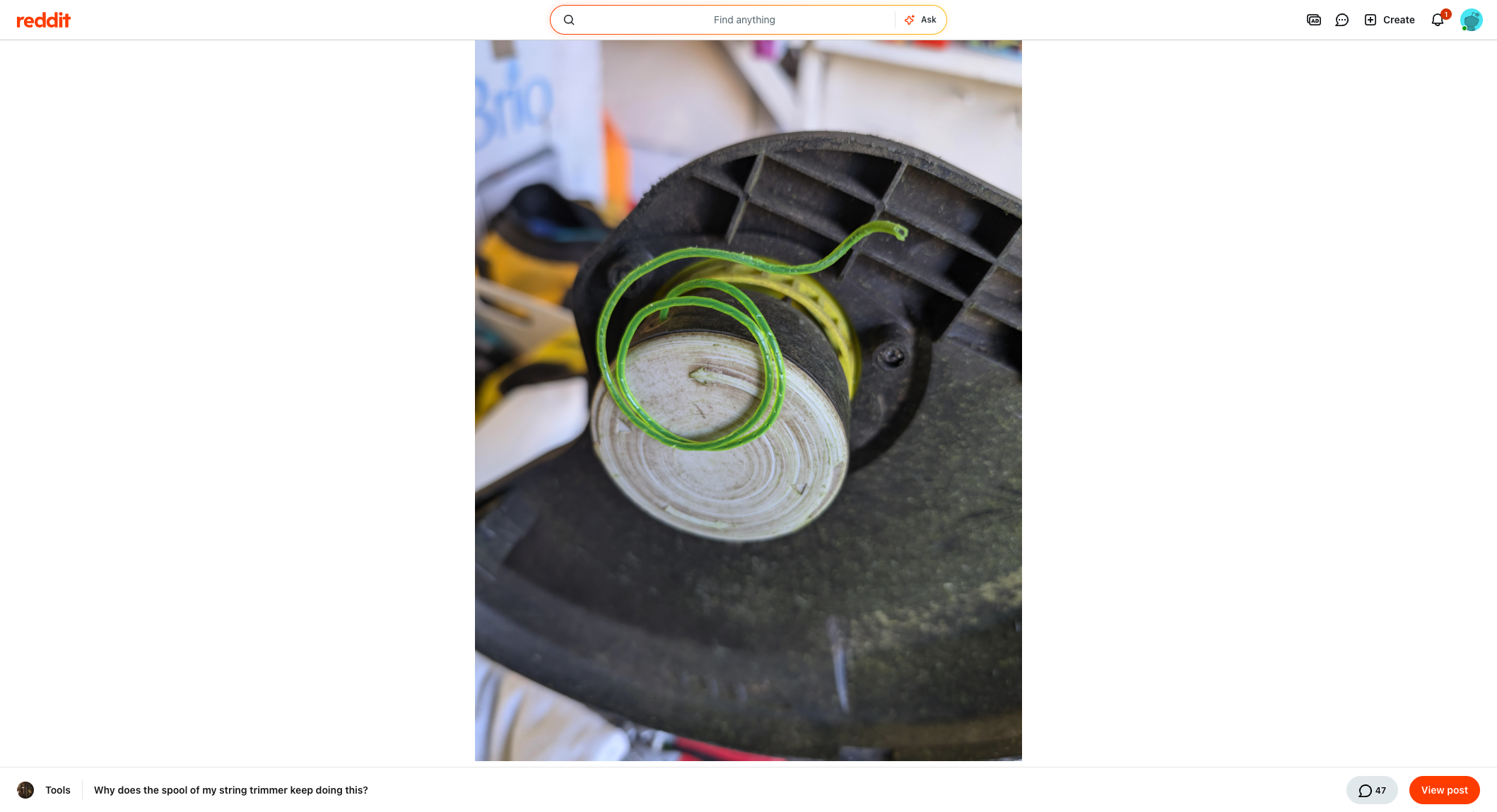
Why trimmer line curls
Nylon trimmer line has “memory” — it retains the shape it was stored in. When wound tightly on a small spool for months, the line takes a permanent set in that coiled shape. When it feeds out, instead of straightening under centrifugal force, it stays curled.
Three factors make this worse:
1. Heat damage from friction
When the line rubs against the spool housing at high RPM, friction generates heat. Nylon softens at relatively low temperatures, and the heat sets the curl permanently. This is the same mechanism that causes spool welding and jamming — just a milder version.
Reddit user u/smokinbbq nailed the diagnosis: “If you wind it too tight, then it can’t flex and come out as needed, and ends up breaking inside.”
2. Dried-out nylon
This is the one most people miss. Nylon is hygroscopic — it absorbs moisture from the air, and that moisture keeps it flexible. When a spool sits in a hot garage or shed for months, the line dries out and becomes brittle and stiff. Dry line holds its coiled shape aggressively.
u/Taossmith shared the fix that got the most upvotes: “Store your string in a bucket or bag of water. It’s drying out and becoming brittle.”
u/-Skybopper- confirmed: “I had to replace a spool of line because it dried out and I couldn’t rehydrate it. It was breaking frequently and I ended up having to get a new spool.”
3. Wrong line diameter for the head
Line that is too thin for the spool housing has room to shift and tangle, which creates uneven tension that sets a curl. Line that is too thick has to be forced into tight bends that permanently deform it.
Check your trimmer head’s rated line diameter — it is usually stamped on the housing or listed in the manual. Most residential trimmers use .080”. Using .065” in a .080” head will curl and tangle more. See our line gauge selection guide for the details.
How to fix curled line
Immediate fix — soak it. Submerge the entire spool in warm water for 24 hours. The nylon reabsorbs moisture and regains flexibility. Pull out a length and let it hang straight — if it relaxes within a few hours, the line is salvageable.
If soaking does not work — replace it. Line that has been heat-damaged or UV-exposed past a certain point cannot be recovered. The nylon has chemically degraded. A new spool of quality .080” line costs $3-6.
Prevent it from happening again:
- Store spools in a sealed bag with a damp paper towel. This maintains the moisture level that keeps nylon flexible.
- Do not store in direct sunlight. UV degrades nylon faster than anything else.
- Wind with moderate tension — snug enough to not tangle, loose enough that the line can flex. Our spool winding guide covers the technique.
- Use twisted line instead of round. Twisted profiles (comparison here) resist curling because the twist creates opposing forces that cancel out the coil memory.

The nuclear option: ditch the spool
If line curling is a recurring problem, the most permanent fix is switching to a trimmer head that does not store line on a spool at all. Fixed-line heads and speed-feed heads (like the Echo Speed-Feed 400) use pre-cut lengths of line that are loaded straight — no coil memory, no curling.
This also eliminates jamming, tangling, and the tedious spool-winding ritual. The trade-off is that you carry spare pre-cut lines instead of having line stored in the head. For most homeowners cutting a standard yard, one loading lasts the entire session.
Key takeaway
Curled trimmer line is almost always a storage problem, not a manufacturing defect. Keep your line hydrated, out of UV, and wound at moderate tension. If the problem persists, switch to twisted-profile line or upgrade to a speed-feed head that eliminates spool memory entirely.
Browse our replacement spools and trimmer line to find the right fit for your trimmer.

Find the right part on Amazon
Check price, stock and fitment — ships direct from Amazon.
§ Parts


